I don't feel I have spent enough time telling you about my observations of general life in Tashkent. You must remember that I'm pretty removed from it as I live so near the Embassy and spend nearly all my time at home alone or at the Embassy exercising and taking Russian lessons. But I'll share what I can.
When we flew in to Tashkent two Septembers ago, if you remember, we landed at sunrise. This is very common. I have seen only one plane in the air since we moved here and that was about a week ago. It was funny because I was walking down the stairs looking out a high window into the sky, saw the plane and stopped dead. What is that, I thought? Flights generally leave and arrive between the hours of 1:00 a.m. and 4:00 a.m. The men who work closely with Douglas are expediters. They help us with arriving and departing at the airport. That's their overtime. They then work full time hours during the day. They make our travel life so easy for us and they do it with a sincere smile. When my parents arrived, Doug and I picked them up. We stood there waiting and waiting. The entire group of passengers checked through and my parents were not there. It seems that even though my mother had wheelchair access requested (arthritis, previous broken knee, etc.) she was not provided with a wheelchair in Uzbekistan. The airport has one wheelchair and there was a sick man sitting in it. The thought of sitting him in a chair while they fetched my mom apparently didn't occur to them. They had to lower her on the service lift from the plane onto the tarmac and bodily assist her. She was in her usual gracious good spirits and smiling happily when she finally came into sight.
Remember my telling you that I came here with an attitude of "It's now right; it's not wrong - it's different"? Well, Douglas helped me keep that attitude recently. I think I've already mentioned how fast people drive here and how slowly they walk. They also have a very different spacial concept than we do. For shy people who don't like to hug, they don't mind walking into you or pushing their way in front of you into a line. When passing (facing) someone on a sidewalk, they will wait until they are going to make contact before moving ever so slightly to avoid this, all the while staring straight ahead like there's nothing/noone else around. One day I was walking to the Embassy - about a block and a half away. There was a group of four young people headed towards me taking up the entire sidewalk. Just behind them was a young woman who was intent on passing them. Between all of us was a tree growing in the middle of the sidewalk. I saw the future so I stopped dead in my tracks to watch the show and stay out of the way. The young woman managed to pass them and was headed toward me (who was standing properly on the right side of the sidewalk). She appeared to be doing the normal waiting until the last micro-second to move, but instead she plowed right into me knocking me off the sidewalk into the mud. Everyone turned and looked at me as I looked at her. I was - unfortunately - speechless. Oh, I had plenty to say - in English! Корова (pronounced karova with a long o) was the only Russian that came to mind. That means cow. I held my tongue. But I stewed about it for way too long with the usual wasted thoughts of, "I should have . . ." and "If I ever see her again I'll . . ." etc. When I told Doug, he reminded me how oppressed these people are and that that was probably her only bit of power in her life. Boy was I humbled. I wish I could go back in time and walk back to her, ask her if she's okay and ask her why she did that instead of just glaring nastily at her.
I have one annoyance here that I also had in the States. Plastic bags at the check out counter. If I bought three small items, the bag boy at the store near Doug and I in St. Paul would put each item in a bag - three bags! I'd take two out and put them all in one bag. I got smart and brought my own canvas bag. Then he'd put my groceries into a plastic bag and then put that in my canvas bag. No kidding. I explained to him that the idea of carrying the canvas bag was to not use a plastic bag. Duh. Sometimes I'd forget my canvas bag and I'd have to deal with the bag boy. I would tell him, "One bag, please." He would then take two bags, put on inside the other and put my three items in them. Sigh. So, here in Tashkent the problem continues. According to Doug, it's old school to carry around your own bag because now they have these plastic bags to offer their customers. These are the cheapest plastic bags you will find. If anything is remotely sharp or of any weight, the bag splits open. So I carry my own bags. Grocery stores really don't like this and they constantly tell me that I can't bring them in. Before I spoke as much Russian as I do now I just smiled and said thank you and kept walking. Once they sent someone to follow me around the store as I shopped. I guess that was to make sure I didn't steal anything. It was handy, though, because he knew where everything I wanted was! Anyway, while Doug and I were Christmas shopping recently I bought three small wooden-handled bread presses. The man and I dickered over the price, we met in the middle and I was reaching in my purse for money. He turned to get a plastic sack. I told him I didn't want a plastic sack. Yes you do, he said. I picked up the bread presses and assured him that I did not. We argued as I dug out money to pay him. Doug stepped in to help. No good; he was adament. Doug finally turned to me, "Just take it" he said. "No", I answered. "I don't want it. The car is 20 steps away." The man tried to pull the presses out of my hand. I held strong. Finally, I said "If you'll come down on the price, I'll take the sack." He lowered his price! Can you believe that? He lost money and product instead of just letting me carry the presses away in my hand. It's not right; it's not wrong - it's different.
It amuses me that the same people who believe that standing in front of a fan or drinking anything cold will make you sick are the same people who believe that rinsing a glass in tap water is washing it. After months, I saw my housekeeper do this. After she drank from one of our glasses, she gave it a quick rinse and put it away as clean. I had to explain to her that anything that goes in someone's mouth must be washed in hot water with soap. She turned on the faucet and stood there looking at the ceiling while waiting for the water to get hot - about a minute and a half wait in our house.
Appearances - especially in front of certain people - are very important here. The roads are in very poor condition except where the president regularly rides. Every time Secretary Clinton has visited our Embassy there has been a major improvement to the street in front of it. Dress is generally basic black if you are younger (teens through 20's or 30's). It seems to be required that young women wear stilletto boots with the highest heels imaginable.Older women wear COLOR. Very common is a flowery dress with brightly colored socks not remotely in any color family represented in the dress and sandals and a scarf. Men like suits in a shiny fabric that reminds me somewhat of disco days. And they spit all the time. I try to never look at them. The men look their best when it's quite cold. They wear a traditional thick robe-like garment and a tallish fur hat. Handsome.
I'm being awfully negative. I think that's because it makes for more humorous writing. So let me end with telling you that I'm familiar enough with a few locals who work the shops and bazaars that we greet each other on the street and converse. That's special to me. On Christmas day I took a box of homemade candy (yes, I shared) and gave it away to the guards here at the compound and the Embassy and to the shopkeepers that are so nice to me. They don't celebrate Christmas, at least not on December 25 - many celebrate Orthodox Christmas on January 7th - but they told me Merry Christmas in English. Sweet. Many people are very interested to know where I'm from and why I'm here. I bought some carrots from a new store - so dirty I didn't know they were yellow carrots until I got them home - and Rustam, the man who sold them to me, was so kind. He's learning English and wanted to practice just a little. I'm getting comfortable enough with Russian that I can joke a little. That same day, I realized that I needed onions so I went to my regular produce man on another corner. He asked me if I wanted carrots because I usually buy carrots from him. I apologized and told him that I just bought carrots somewhere else. I also told him that they were so dirty I'm sure I paid as much for the dirt as I did for the carrots. We laughed. He pointed out his clean carrots. Even in the nice stores, the produce is often filthy. It's like they're pulling it right out of the ground. Another time I asked one of the guards if he went to the big New Year's party. Yes, he did. I asked him if he danced alot. Yes. I asked him if he danced on the table. He laughed. I think it's extra funny coming from me because I'm so slow at forming thoughts sentences. By the time they realize what I said, it's funnier.
Saturday, January 7, 2012

Friday, December 2, 2011
Wednesdays at the Rose Household
Usually every Wednesday Doug and I have what we call "Hump Day Happy Hour". This was Doug's grand idea. We began by inviting the people who live in the compound and have branched out to inviting various other groups - one at a time as we don't have a lot of space. They are popular events. It has been an excellent way for newcomers to meet several people in a relaxed atmosphere. Several people who live in the compound are single and appreciate the regular, easy access to company after work. I put out drinks and appetizers, people bring offerings sometimes and I select some CDs to play. People always know it's Happy Hour night in the summer when we put out the flage - Uzbek and American. During the Winter we set out lanterns on the steps and light them.
Last Wednesday we invited our music teachers plus a few more musicians and we had a night of Uzbek folk music. Doug invited his staff to join us. We hired the cafeteria staff to cook the national Uzbek dish of plov. Plov (pronounced with a long 'o') is a spiced rice and lamb dish with bits of carrots and currants in it. It is tradition to make it every Thursday. The men make plov. Hamid and ___ arrived around 4:00 to start cooking on the patio. They brought a special bowl for cooking the plov in which sits over fire. I eat plov every Thursday at the Embassy and look forward to it, but after tasting it cooked outdoors over the fire I now know why the locals go out for plov on Thursdays. (It's like the difference between putting ground beef in a skillet or on a grill.) There is a place called the Plov Center which cooks plov in enormous 'bowls' outside where you can watch. They serve their plov with a quail egg on top. There are many variations.
We probably had between 25 and 30 guests Wednesday. It was pleasantly crowded. One of the men who Doug works with grabbed our camera and took pictures and videos throughout the night. He got some good video of the musicians including when Doug sang and when I sang. We're (translate: Doug is) looking into posting them on a site like Shutterbug or something so you can see them. I'm told they're too big to put on my blog.
I think our house must be known as the party house because all I have to do is approach the guard at the gate with a piece of paper in my hand and whoever is on duty says, "Гости?" (pronounced "ghosty") meaning, "Guests?"
One of the musicians was a doira player (the Uzbek folk drum). At the end of the night he told our teacher that he wanted to have Douglas and I over to his house for Lagman (a delicious noodle dish traditionally made with one very, very long noodle - we're talking yards) and music. I think that music is going to be our ticket to societywherever we travel. It's a bond appreciated by everyone. There are some men who work in a market I frequent who occasionally ask me how my music lessons are coming along. Once they asked me who my teacher was. When I mentioned Marmurjan's name they all smiled and nodded. They knew him!
Once on my way home from the Embassy I stopped to chat with the gate guard. I showed him my music. He started drumming on the desk with his fingers and singing one of my songs. I joined in and we two strangers - a male and a female in a primarily Muslim country - sang the entire song together. That's special.


Last Wednesday we invited our music teachers plus a few more musicians and we had a night of Uzbek folk music. Doug invited his staff to join us. We hired the cafeteria staff to cook the national Uzbek dish of plov. Plov (pronounced with a long 'o') is a spiced rice and lamb dish with bits of carrots and currants in it. It is tradition to make it every Thursday. The men make plov. Hamid and ___ arrived around 4:00 to start cooking on the patio. They brought a special bowl for cooking the plov in which sits over fire. I eat plov every Thursday at the Embassy and look forward to it, but after tasting it cooked outdoors over the fire I now know why the locals go out for plov on Thursdays. (It's like the difference between putting ground beef in a skillet or on a grill.) There is a place called the Plov Center which cooks plov in enormous 'bowls' outside where you can watch. They serve their plov with a quail egg on top. There are many variations.
We probably had between 25 and 30 guests Wednesday. It was pleasantly crowded. One of the men who Doug works with grabbed our camera and took pictures and videos throughout the night. He got some good video of the musicians including when Doug sang and when I sang. We're (translate: Doug is) looking into posting them on a site like Shutterbug or something so you can see them. I'm told they're too big to put on my blog.
I think our house must be known as the party house because all I have to do is approach the guard at the gate with a piece of paper in my hand and whoever is on duty says, "Гости?" (pronounced "ghosty") meaning, "Guests?"
One of the musicians was a doira player (the Uzbek folk drum). At the end of the night he told our teacher that he wanted to have Douglas and I over to his house for Lagman (a delicious noodle dish traditionally made with one very, very long noodle - we're talking yards) and music. I think that music is going to be our ticket to societywherever we travel. It's a bond appreciated by everyone. There are some men who work in a market I frequent who occasionally ask me how my music lessons are coming along. Once they asked me who my teacher was. When I mentioned Marmurjan's name they all smiled and nodded. They knew him!
Once on my way home from the Embassy I stopped to chat with the gate guard. I showed him my music. He started drumming on the desk with his fingers and singing one of my songs. I joined in and we two strangers - a male and a female in a primarily Muslim country - sang the entire song together. That's special.
Our teacher, Mamurjan, is on the right side.

The plov!
Friday, November 18, 2011
To Khiva
Doug and I went to Khiva Saturday. Khiva lies west of Tashkent (about an hour by air) near Urgench. As with much of Uzbekistan it is full of history and beautiful buildings.

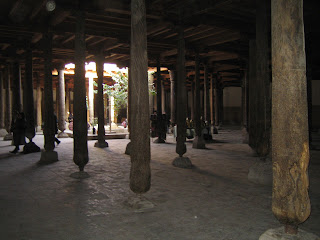
Most impressive to me was the amazing patterns of blue, green and white tiled walls of the madrassas (schools), the elaborately painted tri-panelled ceilings that looked down on these walls and one mosque that was full of 230 intricately carved wooden columns. The artwork is truly stunning. I could have taken hundreds of pictures just to try and capture each pattern represented. Symbolism is rife in the patterns. Our guide, Timur, pointed out that the figure that we, unfortunately, know as the swastika is an old Zoroastrian symbol innocently present long before the nazis. If you looked closely you could also find figures of Hindi gods like Shiva and Ganesh, the Christian cross, Star of David, arms and fingers reaching up in praise and, I’m sure, many hidden symbols - the meanings of which have yet to be disciphered. One column combined the various religious symbols signifying man’s unity. Supposedly the meaning of that was not made known when it was originally carved as that would have been met with ugly opposition. I wish more of our world were ready for it today.


I need to develop a better attitude towards vendors. I tend to shut down when people are shouting at me and pushing goods in my face, even when I am interested in buying something. I wanted to buy some Christmas gifts while in Khiva. Doug and I were looking for some decoratively carved cutting boards we had seen earlier. One young woman started in on us to come closer and look as she named all the things she had - even though they were in plain sight and we were already looking at them. He told her we were looking for cutting boards, which were not in sight. She said she had some. In the meantime another woman said that she had cutting boards. Doug went one way and I went the other to see cutting boards. Though pretty, they were poor quality, barely sanded smooth and unfinished. The woman who was showing Doug the boards kept yelling at me to get my attention. I ignored her as I was with someone in conversation. At one point she yelled in an ugly tone of voice, “Get over here!” She did this twice. We left. Earlier the silk vendor Timur introduced us to came over to us humbly, looking a little embarrassed at the attention and with a slight smile and showed us into his shop. I liked him. Even if I hadn’t been looking for suzani, I would have just wanted to buy something from him. I bought three suzani. I wish I had more language skills to tell that woman why I’d never even consider buying from her. I also wish I had a better attitude towards these people who work so hard, earn so little and are so desperate to prove themselves.
In the week leading up to the trip I read “A Carpet Ride to Khiva” by Christopher Aslan Alexander. He lived in Khiva for seven years and would probably still live there had he not made himself unpopular with the corrupt politicians he encountered. He started a carpet school/shop with high standards of using natural dyes and old school methods of weaving and pattern seeking eventually becoming the largest employer in the area. If you’re curious about the history of the area and life today I recommend reading his book. It is witty and informative without going overboard and helps develop perspective on the differences between our cultures. Some things you read will be disturbing like it’s illegal to beat your wife - in public. The government corruption is so rampant you may find yourself angry for these people. I can understand how lying is so prevalent, understood and accepted here.
I have often found myself wondering, “How, in this day and age, can anyone . . .?” Someone I shared the following story with said, “Well, until they (the Uzbeks) decide that they don’t want to live that way anymore, that’s what they’ll have.” As though they can change it by admitting that they don’t want to live that way. I have a short answer to that. There was a horrible massacre in Andijon in 2005. There was a protest over the bogus arrest of a prominent citizen. The people (mostly women with their children in tow) gathered outside the prison and waited asking for his release. There are many versions of this story. They were peaceful and unarmed. Tanks were positioned ‘just in case’. Depending on whose version you believe, some radicals heard of the peaceful protest and showed up. Eventually gunfire broke up. The tanks were moved in and indiscriminately gunned down everyone they could. Official death toll was 169; eye-witnesses put it in the area of 500-700. Quite a difference. What is unfathomable to us is that people in Khiva (and other parts of Uzbekistan) didn’t even know what had happened for some time. News programs are regularly blocked in Uzbekistan.The people had no way of knowing. The government regularly runs programming that features people (often children) singing songs about Uzbekistan. They are kept ignorant. The writer had access (somehow, that’s unclear to me) to BBC and knew of the uprising. It could be a simple matter of cable being too costly for the average citizen, I don’t know. I do know that certain internet sights remain blocked. Today news sights that have news of this area are blocked, Google maps is typically blocked, some American newspapers are blocked (sometimes by article; sometimes the entire sight), local newspapers are about four pages long and are full of editorials that pass as articles about how good the Uzbek government is. For their recent 20th Anniversary celebration a program was run on (and on and on) television of a split screen; half showing riots in France, half showing people picnicking in a Tashkent park, half showing the twin towers being attacked and half showing people playing music on the street in Tashkent. The message: life is good here; you don’t want to go there. It’s really unbelievable, but it’s true.
Ignorance here goes deeper than political and world news. I asked a woman in the gym bathroom recently how her exercise went that day. She said she didn’t exercise because she was on her period. I just said something like, ‘yeah, sometimes I don’t feel like it either.” She waited a minute then asked if it was okay to exercise when on our period. Yes, I assured her, we can. This woman was about 30. I have often alarmed the cleaning crew when, after I exercise, I stand in front of a fan to cool down. They worriedly tell me that I'll get sick. Every time I cough, my Russian teacher feels how cold my water is because they believe drinking cold water will make you sick. Sometimes it's funny, but, really, it's sad that they are kept ignorant to a large degree.There are some horrifying stories in the book about medical practices here.
Since leaving Khiva I have learned that some of Uzbekistan (excluding Tashkent) is limited to two or three hours of power per day. This goes on while the government sells power to neighboring countries. This goes on during the scorching summers (most homes have no air-conditioning anyway) and the frigid winter.
It amazes me that they not only survive, but they can create such beauty as we saw in Khiva and as we see in the local bazaars. I wish that the players of the Uzbek folk music with the rapid fingered rhythms of the doiras, the singing and whining of the gidzhak (a small violin-like instrument played in the lap like a cello) and the strumming of the dutar (a long, narrow, two-stringed guitar-like instrument) and the dancers didn't have to put up with this nonsense. And I wish that the people I've met at the Embassy, our compound and the nearby shops had the freedom to access information so they can have the knowlege to form informed opinions and safely voice those opinions.
Mostly, I wish that our world's leaders would know when it's time to step aside. I wish this could be seen as an act of wisdom instead of weakness. (Think of George Washington when he said, after being asked to serve a third term, that two was enough for one man.) I look forward to a day when the power of wisdom eclipses the power of might and the influence of wealth.


I need to develop a better attitude towards vendors. I tend to shut down when people are shouting at me and pushing goods in my face, even when I am interested in buying something. I wanted to buy some Christmas gifts while in Khiva. Doug and I were looking for some decoratively carved cutting boards we had seen earlier. One young woman started in on us to come closer and look as she named all the things she had - even though they were in plain sight and we were already looking at them. He told her we were looking for cutting boards, which were not in sight. She said she had some. In the meantime another woman said that she had cutting boards. Doug went one way and I went the other to see cutting boards. Though pretty, they were poor quality, barely sanded smooth and unfinished. The woman who was showing Doug the boards kept yelling at me to get my attention. I ignored her as I was with someone in conversation. At one point she yelled in an ugly tone of voice, “Get over here!” She did this twice. We left. Earlier the silk vendor Timur introduced us to came over to us humbly, looking a little embarrassed at the attention and with a slight smile and showed us into his shop. I liked him. Even if I hadn’t been looking for suzani, I would have just wanted to buy something from him. I bought three suzani. I wish I had more language skills to tell that woman why I’d never even consider buying from her. I also wish I had a better attitude towards these people who work so hard, earn so little and are so desperate to prove themselves.
In the week leading up to the trip I read “A Carpet Ride to Khiva” by Christopher Aslan Alexander. He lived in Khiva for seven years and would probably still live there had he not made himself unpopular with the corrupt politicians he encountered. He started a carpet school/shop with high standards of using natural dyes and old school methods of weaving and pattern seeking eventually becoming the largest employer in the area. If you’re curious about the history of the area and life today I recommend reading his book. It is witty and informative without going overboard and helps develop perspective on the differences between our cultures. Some things you read will be disturbing like it’s illegal to beat your wife - in public. The government corruption is so rampant you may find yourself angry for these people. I can understand how lying is so prevalent, understood and accepted here.
I have often found myself wondering, “How, in this day and age, can anyone . . .?” Someone I shared the following story with said, “Well, until they (the Uzbeks) decide that they don’t want to live that way anymore, that’s what they’ll have.” As though they can change it by admitting that they don’t want to live that way. I have a short answer to that. There was a horrible massacre in Andijon in 2005. There was a protest over the bogus arrest of a prominent citizen. The people (mostly women with their children in tow) gathered outside the prison and waited asking for his release. There are many versions of this story. They were peaceful and unarmed. Tanks were positioned ‘just in case’. Depending on whose version you believe, some radicals heard of the peaceful protest and showed up. Eventually gunfire broke up. The tanks were moved in and indiscriminately gunned down everyone they could. Official death toll was 169; eye-witnesses put it in the area of 500-700. Quite a difference. What is unfathomable to us is that people in Khiva (and other parts of Uzbekistan) didn’t even know what had happened for some time. News programs are regularly blocked in Uzbekistan.The people had no way of knowing. The government regularly runs programming that features people (often children) singing songs about Uzbekistan. They are kept ignorant. The writer had access (somehow, that’s unclear to me) to BBC and knew of the uprising. It could be a simple matter of cable being too costly for the average citizen, I don’t know. I do know that certain internet sights remain blocked. Today news sights that have news of this area are blocked, Google maps is typically blocked, some American newspapers are blocked (sometimes by article; sometimes the entire sight), local newspapers are about four pages long and are full of editorials that pass as articles about how good the Uzbek government is. For their recent 20th Anniversary celebration a program was run on (and on and on) television of a split screen; half showing riots in France, half showing people picnicking in a Tashkent park, half showing the twin towers being attacked and half showing people playing music on the street in Tashkent. The message: life is good here; you don’t want to go there. It’s really unbelievable, but it’s true.
Ignorance here goes deeper than political and world news. I asked a woman in the gym bathroom recently how her exercise went that day. She said she didn’t exercise because she was on her period. I just said something like, ‘yeah, sometimes I don’t feel like it either.” She waited a minute then asked if it was okay to exercise when on our period. Yes, I assured her, we can. This woman was about 30. I have often alarmed the cleaning crew when, after I exercise, I stand in front of a fan to cool down. They worriedly tell me that I'll get sick. Every time I cough, my Russian teacher feels how cold my water is because they believe drinking cold water will make you sick. Sometimes it's funny, but, really, it's sad that they are kept ignorant to a large degree.There are some horrifying stories in the book about medical practices here.
Since leaving Khiva I have learned that some of Uzbekistan (excluding Tashkent) is limited to two or three hours of power per day. This goes on while the government sells power to neighboring countries. This goes on during the scorching summers (most homes have no air-conditioning anyway) and the frigid winter.
It amazes me that they not only survive, but they can create such beauty as we saw in Khiva and as we see in the local bazaars. I wish that the players of the Uzbek folk music with the rapid fingered rhythms of the doiras, the singing and whining of the gidzhak (a small violin-like instrument played in the lap like a cello) and the strumming of the dutar (a long, narrow, two-stringed guitar-like instrument) and the dancers didn't have to put up with this nonsense. And I wish that the people I've met at the Embassy, our compound and the nearby shops had the freedom to access information so they can have the knowlege to form informed opinions and safely voice those opinions.
Mostly, I wish that our world's leaders would know when it's time to step aside. I wish this could be seen as an act of wisdom instead of weakness. (Think of George Washington when he said, after being asked to serve a third term, that two was enough for one man.) I look forward to a day when the power of wisdom eclipses the power of might and the influence of wealth.
Friday, November 11, 2011
I Know an Old Man
I know an old man who’s quickly aging. His eyes won’t see what they used to see. His ears won’t hear what they used to hear. His knees are tired of supporting him. His breathing weakens when it used to be strong. Of course this didn’t happen all of a sudden, yet it did.
When his car doesn’t work, he has no problem taking it back to the dealer and paying to have them fix it. When his body doesn’t work he waits for it to fix itself. Sometimes it does. Sometimes it doesn't. I hope he’s learning to take his body’s concerns to his Maker and his Maker’s assistants (otherwise known as doctors) even though it’s not easy.
It’s okay today for a man to acknowledge fear, but he’s still not comfortable admitting his fears. It’s okay for a man to be sad or frightened, but it’s so much easier to be angry.
I wonder if he remembers all he’s seen through those failing eyes. I hope those pictures are alive in his sharp mind. I wonder if he remembers all the voices and sounds he’s heard through his deafening ears.
May the music of his life play on in his mind to the end of his days.
When his strength is gone will he recall all the jobs he labored at? All the sports he played? Does he know that it’s okay to rest now?
Does he know how vital he still is? Does he realize how many people want to hear his stories? Does he really believe that it’s never too late to learn? What a difference he would make in the lives of others by setting such an example as taking a class.
When he considers his regrets in life, does he realize that he can still repair some relationships or do some deeds left undone?
Does he know that seeing apology as weakness is old school? That we’ve evolved past that and realize the strength it takes to admit wrong doing and say “I’m sorry?” I hope he knows by looking at others’ lives that sometimes one’s regrets are regrets to them alone; they don’t affect other people as may be feared. Even genuine regrets may have some good repercussions as we learn from each other.
I think he grew up in a time when a man worked hard for a good life; now he sees so many people with easier jobs and fewer home responsibilities that require their own hands and time. While that’s encouraging and impressive, I think it can brew some bitterness. I hope he knows that it’s okay to let someone else help him around the house today.
I hope he knows that in accepting help he’s also helping.
Thursday, November 3, 2011
A busy month
October was a busy month at the Embassy. Earlier there was a concert by a popular group that has been performing together in Uzbekistan New York , New York
I’m writing this on Sunday, October 23 (posting it on Thursday November 3 - I'm slow). This morning the Embassy had its second visit by Secretary of State Hillary Clinton. She was in town from Afghanistan Tajikistan Tajikistan
The weeks leading up to such a visit are quite busy at the Embassy. People’s work loads increase greatly. People step in to do extra jobs to prepare for the visit. They attend to the pre-arrival staff of Secretary Clinton, set up a control room where she and her staff will be staying and keep in close touch with Washington and her staff which means people like Doug checking his Blackberry whenever he awakens during the night. I walked into his office one day and he had two phones, an active radio and his Blackberry – three of which were going off while I was there. He was sort of rewarded this visit, however. Last year his boss was out of town and Doug was so busy running not only his section but others that he never even got a glimpse of Secretary Clinton. This year it was requested that he ride in her motorcade. I think all that meant was that he got to glimpse her several times while he ran the motorcade, but at least he got to see her.
That night we had what is called a ‘Wheels Up Party’. After everything is over with at the Embassy and their responsibilities with her visit have come to an end, we celebrate.
Thursday, September 29, 2011
More about Italy
The excitement of being in Italy was enough to keep me high our entire trip, but it's the details that stay with me in my memory.
These cities are so old and contain so much charm. I took several pictures of doors and their decorative knobs and elaborate knockers.


The streets are cobblestone. There are a few old stone gate entryways scattered about of which Doug took pictures.


These cities are so old and contain so much charm. I took several pictures of doors and their decorative knobs and elaborate knockers.


The people who live and work behind these curious doors must have lots of patience and love for humanity for every day they contend with driving their cars through these twisting, steep streets full of oblivious tourists. I never heard a cross word nor did I see an exasperated face. Maybe if I could eat like they do every day I'd be alot more patient, who knows?
We looked inside the Temple of San Biagio that sits at the hill of Montepulciano. Here's a wide view inside:

The streets are cobblestone. There are a few old stone gate entryways scattered about of which Doug took pictures.

Notice the window above as evidence that someone lives there. How would you like to be about to tell someone you live above the east gate in Montepulciano, Italy?
The streets run between tall, old, stone and brick buildings but every once in a while there is an alley down which you can see The View, similar to this. The pictures I took down the dark alleys leading to views like this didn't turn out.

We arrived in Montepulciano under a full moon so we usually took a walk after dinner to take in these views under the moonlight. Very romantic.
We were not always out running around. We spent plenty of time in the room, the courtyard at the hotel or sitting in a park reading. We started one day doing some yoga in our room. I was reminded that poses, like Mountain, are active poses. (For those of you not familiar with yoga, Mountain pose is a basic standing position, hands held open and muscles engaged for balance and posture.) This reminded me that I can be active in life without being physical. This is something I know, but should realize more often.
There was a artist's exhibition in a building next to the park that we went to see. The artist carved figures from olive trees - only fallen, naturally lost olive trees, none were cut down for this. The most striking display, to me, was The Last Supper in which each disciple and Christ were represented by their hands alone. The thought this man put into what Peter's hands would look like in contrast to Bartholomew's was interesting.
One of our walks led to a cemetary with a huge, old, rusted iron gate at the entrance. We walked around and noticed, humorously, that the rest of the cemetary was surrounded by a very short wall that anyone could have climbed or hopped over. I can't express how much I loved taking walks there. It was always accompanied with an "if my friends could see me now" feeling of excitement. I even asked God once if He could see me! The last time I felt this was on a beach on the Aran Island of Innishmore off Ireland. The moonlight shone on the water and I wept, it was so beautiful.
The beauty of the agriturismo we stayed at near Volterra (Marcampo) was very different than Montepulciano. It was not as green. It still had rolling hills, but the hills were covered with what looked like cut hay. I walked and walked over and around these hills. There was a huge grove of trees that I wanted to walk around, but, as I tried, I realized that the grove just kept going with no break and after a couple hours or days (I lost track of time in fear of becoming truly lost) I gave up and went back to our room.

I got up twice at sunrise and walked to see the shepherds with their sheep. They talk and whistle to them and I loved listening. I tried to record it, but between the wind and the distance it didn't turn out. The first morning I saw them I was on the hill and they were in the valley below. I kept glancing over listening an watching. Soon I realized that the watcher was being watched. I raised my hand in a wave and in response I heard, "Ciao!" "Ciao" I shouted back. More chat was volleyed back, but my Italian was exhausted. I can still hear them in my head, I really wish I could have recorded it successfully. It sounded much different than the Uzbek shepherds and goatherds I hear in the mounains of Uzbekistan.
When I go on trips like this that I so thoroughly enjoy I wonder how I can take some of it home with me. One way to bring Italy home is flowers. Flowers spill off every doorstep, dangle off every wall and, sitting in pots, fill every street. On one walk, I saw one tiny flower in a very small pot that was quite dry. All we had with us was our Camelbak so I sucked in some water, spit it into the soil and repeated enough times to give it a good watering. I enjoyed the flowers so much I somehow felt obligated to help the little guy out.


Friday, September 9, 2011
Perks
There are many perks in serving in the Foreign Service besides the obvious of living abroad and gettng the extensive training available. One is R&R. Some posts, like Tashkent, are considered remote and those serving there are given paid trips once a year (if they serve the full two years at post). The R&R destination for Tashkent is Rome, Italy.
On August 11, Doug and I left Tashkent for Doug's first vacation in over two years.
We flew into Rome and immediately drove up into the Tuscany region anxious to get out of the big city. We spent nine nights in Montepulcciano - an old hilltop town overlooking vineyards and olive groves. We quickly fell into a nice routine of exploring Montepulcciano in the morning, lunching, enjoying gelato after lunch, taking one last walk then escaping the heat by reading and napping in our room. I usually took an afternoon walk, sometimes Doug would join me. For dinner we ate at the same small cafe every night which was right next to our hotel. Every other day we'd leave Montepulciano for a short drive to a neighboring city (also hilltop) to look around and hunt out the best pasta, pizza or panini and, of course, gelato.
Montepulciano was charming as were all the cities we visited. It was divided into neighborhoods marked with flags, each flag representing a family. There were many fun shops including leather shops mostly filled with bags, a shop full of hand knit wear, a paper and pen shop, one full handmade leather bound books and a wall full of ornate wrapping paper sold by the sheet, one of those knick-knack shops full of things you don't need and maybe even don't want, but you just have to stop and look, artist shops with paintings, mosaics (we go to watch him work) and a shop full of very old drawings of Italian scenes from the land and life and maps. We played an ongoing game "If we had all the money in the world we'd buy . . ." Boy do you wish we had all the money in the world; we really "shopped" for you!
We mostly saw outdoor sights like the old city gates (of which Douglas took many pictures), old fountains still in use, wells, doors ornamented with decorative knockers and/or knobs (of which I took many pictures), churches and narrow alleys winding between people's homes at which on every doorstep and window ledge sat pots of trailing flowers. Upon following these alleys we'd often come upon another view. Every view was breathtaking. I wanted to take a panorama of every hilltop view over that beautiful land. Panoramas take up lots of memory, I almost got cut off by Douglas. Speaking of pictures, we are looking to post all of our pictures on a sight so you can go there and view as many as you want. I'll let you know when we (Douglas) does this.
The walks we took were my favorite part. Each walk began downhill. We had our pick of a few roads leading to more major roads or lesser roads threading between vineyard, orchards and homes. We saw, of course, grapes growing everywhere, acres and acres of olive trees, apple trees, plum trees, pear trees, some berries and at least one fig tree. It was hard to resist dashing into the vineyards just to taste. We were good; we didn't. We did, however, have some plums and pears. These had fallen by the wayside along the road and we figured they were fair game. They were so sweet it was a shame to see them just laying there. The walk back was, naturally, back uphill, but it usually resulted in a meal which we were very ready for. After our nine nights in Montpulciano, we drove to Volterra and stayed in an agriturismo nearby. It, too, was on a hill so all our walks began downhill. One night at twilight we were walking down a road and saw what we thought was a very strange looking dog sitting in the middle of the road looking at us. We stopped and soon it's brothers and sisters came traipsing out of the bushes. They were wild boar piglets (wild boarlets???). Soon after came mom and dad and another adult or two. We froze. Thank God, the adults never noticed us, they just bolted across the road. The walks were very different in Volterra. The land was not full of vineyards. The surrounding hills were covered with cut hay so it was colorless compared to Montepulcciano. But the walking was good for me as these hills were smaller and so to walk it was constantly up, down, up, down and it was pretty steep.
The food. Ah, the food. The popular pasta in this region is hand made picci. It is like spaghetti, but much thicker - almost as thick as my pinky. It is so chewy, it is a pleasure to eat. They cook it in such a way that the flavor of the sauce soaks through to the center of the pasta. It was usually served in a ragu sauce. I also tried a cheese stuffed ravioli in a buttery cream sauce with sage. I never saw my favorite veal stuffed ravioli. I had a pasta with wild boar sauce which was very tasty. I wish I had tried more wild boar - sausage, for instance. It was very popular there. A few times we settled for less expensive, but no less satisfying, pizza. And we each had a panini which were okay. Doug fondly remembers some kebabs he ate with bacon, aged pecorino cheese and figs as well as a salad with apples, walnuts, cheese and greens. The pasta ruled. Every night I ate lighter so I didn't gain a bunch of weight so I usually had a bruschetta at the cafe next to the hotel. In Volterra, we had an apartment so we shopped at a grocer and made a lot of our own food so we wouldn't go broke. An average dinner at the cafe of bruschetta, a glass or wine, one of beer and a salad was around $40. Lunches were similar unless we had only pizza. The average plate of pasta was around $9.
The wine. Excuse me, I just wiped a tear from my eye. The wine was delicious. As we were told, even if we ordered the house wine, it was very good. Our favorite was the Nobile, a red wine that came in a few different forms from very drinkable to a rich, thick sipping wine. We went to no wine tastings though almost every meal was accompanied by a glass. Very common there was to not offer a glass of wine, but to offer a liter, half-liter or quarter-liter. I ordered the smallest the first time I saw this offered and drank three glasses of wine. I think their measuring system was quite in favor of the customer. Usually a quarter liter got me a glass and a half. We got to go through a cellar or vault called the subterranean city where wine was stored in huge barrels. It ran underground the span of a shop and restaurant.
I think we are still going through gelato withdrawls. Between the two of us, we ate strawberry, chocolate (guess who?), vanilla (NOT me, wouldn't waste my time), caramel, pistacchio, sour cherry and cream flavors. The thing that amazes me about gelato is the satisfaction I get out of such a teensy serving. It is so rich and creamy that I just want to eat it in tiny bites so it lasts a long time. If I were dishing out ice cream, I'd have at least twice as much.
I have much more details written up about our trip. I'll be posting them in the coming days.
While we were in Italy Doug got the news that his next assignment is going to be in Munich! That was, like Tashkent, his number one pick. We look forward to our last year in Tashkent and don't want to be too distracted with thoughts of living in the Christmas/beer capital of the world.
Here's one of the beautiful views from Montepulciano:

Here is Marcampo where we stayed near Volterra:

On August 11, Doug and I left Tashkent for Doug's first vacation in over two years.
We flew into Rome and immediately drove up into the Tuscany region anxious to get out of the big city. We spent nine nights in Montepulcciano - an old hilltop town overlooking vineyards and olive groves. We quickly fell into a nice routine of exploring Montepulcciano in the morning, lunching, enjoying gelato after lunch, taking one last walk then escaping the heat by reading and napping in our room. I usually took an afternoon walk, sometimes Doug would join me. For dinner we ate at the same small cafe every night which was right next to our hotel. Every other day we'd leave Montepulciano for a short drive to a neighboring city (also hilltop) to look around and hunt out the best pasta, pizza or panini and, of course, gelato.
Montepulciano was charming as were all the cities we visited. It was divided into neighborhoods marked with flags, each flag representing a family. There were many fun shops including leather shops mostly filled with bags, a shop full of hand knit wear, a paper and pen shop, one full handmade leather bound books and a wall full of ornate wrapping paper sold by the sheet, one of those knick-knack shops full of things you don't need and maybe even don't want, but you just have to stop and look, artist shops with paintings, mosaics (we go to watch him work) and a shop full of very old drawings of Italian scenes from the land and life and maps. We played an ongoing game "If we had all the money in the world we'd buy . . ." Boy do you wish we had all the money in the world; we really "shopped" for you!
We mostly saw outdoor sights like the old city gates (of which Douglas took many pictures), old fountains still in use, wells, doors ornamented with decorative knockers and/or knobs (of which I took many pictures), churches and narrow alleys winding between people's homes at which on every doorstep and window ledge sat pots of trailing flowers. Upon following these alleys we'd often come upon another view. Every view was breathtaking. I wanted to take a panorama of every hilltop view over that beautiful land. Panoramas take up lots of memory, I almost got cut off by Douglas. Speaking of pictures, we are looking to post all of our pictures on a sight so you can go there and view as many as you want. I'll let you know when we (Douglas) does this.
The walks we took were my favorite part. Each walk began downhill. We had our pick of a few roads leading to more major roads or lesser roads threading between vineyard, orchards and homes. We saw, of course, grapes growing everywhere, acres and acres of olive trees, apple trees, plum trees, pear trees, some berries and at least one fig tree. It was hard to resist dashing into the vineyards just to taste. We were good; we didn't. We did, however, have some plums and pears. These had fallen by the wayside along the road and we figured they were fair game. They were so sweet it was a shame to see them just laying there. The walk back was, naturally, back uphill, but it usually resulted in a meal which we were very ready for. After our nine nights in Montpulciano, we drove to Volterra and stayed in an agriturismo nearby. It, too, was on a hill so all our walks began downhill. One night at twilight we were walking down a road and saw what we thought was a very strange looking dog sitting in the middle of the road looking at us. We stopped and soon it's brothers and sisters came traipsing out of the bushes. They were wild boar piglets (wild boarlets???). Soon after came mom and dad and another adult or two. We froze. Thank God, the adults never noticed us, they just bolted across the road. The walks were very different in Volterra. The land was not full of vineyards. The surrounding hills were covered with cut hay so it was colorless compared to Montepulcciano. But the walking was good for me as these hills were smaller and so to walk it was constantly up, down, up, down and it was pretty steep.
The food. Ah, the food. The popular pasta in this region is hand made picci. It is like spaghetti, but much thicker - almost as thick as my pinky. It is so chewy, it is a pleasure to eat. They cook it in such a way that the flavor of the sauce soaks through to the center of the pasta. It was usually served in a ragu sauce. I also tried a cheese stuffed ravioli in a buttery cream sauce with sage. I never saw my favorite veal stuffed ravioli. I had a pasta with wild boar sauce which was very tasty. I wish I had tried more wild boar - sausage, for instance. It was very popular there. A few times we settled for less expensive, but no less satisfying, pizza. And we each had a panini which were okay. Doug fondly remembers some kebabs he ate with bacon, aged pecorino cheese and figs as well as a salad with apples, walnuts, cheese and greens. The pasta ruled. Every night I ate lighter so I didn't gain a bunch of weight so I usually had a bruschetta at the cafe next to the hotel. In Volterra, we had an apartment so we shopped at a grocer and made a lot of our own food so we wouldn't go broke. An average dinner at the cafe of bruschetta, a glass or wine, one of beer and a salad was around $40. Lunches were similar unless we had only pizza. The average plate of pasta was around $9.
The wine. Excuse me, I just wiped a tear from my eye. The wine was delicious. As we were told, even if we ordered the house wine, it was very good. Our favorite was the Nobile, a red wine that came in a few different forms from very drinkable to a rich, thick sipping wine. We went to no wine tastings though almost every meal was accompanied by a glass. Very common there was to not offer a glass of wine, but to offer a liter, half-liter or quarter-liter. I ordered the smallest the first time I saw this offered and drank three glasses of wine. I think their measuring system was quite in favor of the customer. Usually a quarter liter got me a glass and a half. We got to go through a cellar or vault called the subterranean city where wine was stored in huge barrels. It ran underground the span of a shop and restaurant.
I think we are still going through gelato withdrawls. Between the two of us, we ate strawberry, chocolate (guess who?), vanilla (NOT me, wouldn't waste my time), caramel, pistacchio, sour cherry and cream flavors. The thing that amazes me about gelato is the satisfaction I get out of such a teensy serving. It is so rich and creamy that I just want to eat it in tiny bites so it lasts a long time. If I were dishing out ice cream, I'd have at least twice as much.
I have much more details written up about our trip. I'll be posting them in the coming days.
While we were in Italy Doug got the news that his next assignment is going to be in Munich! That was, like Tashkent, his number one pick. We look forward to our last year in Tashkent and don't want to be too distracted with thoughts of living in the Christmas/beer capital of the world.
Here's one of the beautiful views from Montepulciano:

Here is Marcampo where we stayed near Volterra:

Subscribe to:
Posts (Atom)