Thursday, November 25, 2010

A Desert is a Desert

A desert is a desert, right? Wrong. There are hot deserts, temperate deserts and cold deserts. Theodore National Park in North Dakota is a temperate desert area. Antarctica is the largest cold desert. The Sahara is the world's largest hot desert with its miles and miles of sand. My home, Phoenix, is right on the edge of the Sonoran desert but, from what I saw, has more dirt and cacti than sand (the dunes are in Yuma). It is scorching and dangerously hot in the summer, dehydratingly dry, not too cold in the winter and it has little changing blue skies that offer rare rain. Yet even though all that lives in the desert is so abused and denied, life thrives.

In Phoenix I'd lay in bed in the morning and hear the cooing and gurgling of doves in the rafters of our house. Here in Tashkent there is a bird that likes to sit on the bars just inches from our bedroom window and blast out its morning calls. It's not too unlike the infuriated parent trying to get a teenager awake and out of bed, but it has a lot more character.


In the afternoons in Phoenix I'd hear the regular rounds of the ice cream trucks playing four bars of either "The Entertainer", "Jingle Bells" (even in July), or "Fur Elise" incessantly for hours. Interspersed between that carnival-like sound is the ding of the tortilla wagon gently proclaiming "fresh tortillas".

In Tashkent the sounds of traffic dominate your senses. People drive with their horns. They honk when they are approaching you (whether you're on foot or in a vehicle), they honk when they pass you. They honk if you're in their way or not going fast enough. In Amerca while traffic lights flash green-yellow-red-green-yellow-red, etc.; in Tashkent they flash green-yellow-red-yellow-green-yellow-red-yellow etc. so the drivers honk whenever the light is yellow and you're not moving forward. They honk if you are approaching a street and look as though you just may walk/drive into it. They also honk for no apparent reason. And these cars have horns that can stop time. They are shrill and LOUD. When Doug's poor Hyundai arrives and we drive I fear it (we)will be ridiculed when we honk or lame little horn.

I dreaded mall-shopping in the states because of the vendors who had kiosks and carts instead of shops. they assault every passer-by interrupting conversation and thoughts with their physical obstacles and desperate sales pleas. In the Tashkent bazaars its the old vendors I notice. They sit until thy have to get up. When I pass I hear them solftly speak of and gently gesture to their fine produce. It makes me want to buy. It makes me want to bring them back a share of the soup I made with their produce.

In the states our currency is paper and coin with many denominations. In Uzbekistan they also have coins and paper. I have yet to see any coins. With inflation where it is I have only seen paper bills in denominations of 100 cym (pronounced "soom"), 200 cym, 500 cym and 1,000 cym. One dollar equals apx 1,600 cym. I think the least expensive item I've bought is an onion for about 800 cym. Uzbekistan is a cash-only society. One must carry a wad whenever going out. Bye-bye "Barbie purse" as my friend Julie lovingly refers to my bag. It's joked in the Embassy that we all look like drug dealers with our stacks and stacks of bills rubber-banded in groups of 100,000 cym and further subdivided into groups of 10 for easy counting at the point of payment. It's not unusual to hear Can you loan me 100,000?" "Sure. " The picture you see is a little over $500 in cym. And, yes (look closely, please) I DO have clothes on!


Friday, November 12, 2010

Your Feedback; My Response

I got comments on my last blog that I want to share. First I’ll show you Calliope’s:

From a historical standpoint, I vote to honor the sacrifice of women and not a few men who secured my right to do so (q.v. 19th amendment). I don't like feeling disenfranchised!

I don't care who sees me or doesn't see me at the poll--I'd love to have a mail-in ballot in Minnesota, so it's not social approval I seek. But I'd get there come hell or high water because I like feeling part of the process. While I alone might not make a difference, WE the people can.

I vote because I'm privileged to live in a civilized society. The corporations that run the country . . . have enough of a say, so even or especially when it seems futile, it's the only way I can register any kind of a complaint that matters. It's as much a vote against apathy as anything on the ballot, and for me, apathy is the biggest sin, so voting is the least I can do.

So... I've read and re-read your blog on this, and I still don't know why you didn't vote! It's not like you don't have time to figure out the issues or where the candidates stand on them. There's a ton of ways you can do that, without listening to one tv ad, either negative or positive. You can watch debates, or read transcripts of them, visit their websites, and read read read. If you're interested.

I agree with letter-writing . . . but I don't know if the numbers-behind-the-numbers argument holds true for email. However, people with computers can crank out a well-written letter just as easily. I do both, (and yes, I used to volunteer, put up yard signs, attend rallies, and march in protest, too) and I applaud your neighbor's efforts. But that power goes only so far if it's ultimately a substitute for voting.

Thank you, Calliope.

Another reader pointed out how devastating it would be to our system if everyone felt that their vote didn’t count and, therefore, didn’t vote. I agree.

I swiftly pointed out to this person that, although my individual vote does not make any difference mathematically – it won’t change the outcome, if EVERYONE who believed that didn’t vote, that WOULD make a difference. But I also said that, although my individual vote won’t change the outcome, it matters morally and ethically and statistically whether or not I vote.

To me, he was changing too much about my statement to make any sense. He was kind of arguing a point I wasn’t making. I recognized this because I have done this plenty of times.

Some may say he was comparing apples to oranges. (It always makes me scratch my head when people say that. They’re both fruit, for crying out loud. They have a lot in common! I guess that expression is just lost on me.)

This brings me to address an issue I have now brought up twice: the fact that we need to learn how to debate each other. I don’t believe we stand a chance at living in a more peaceful world if we cannot argue civilly with our relatives, friends and neighbors. Since I have said this before I decided that I should offer some solutions.

I used to argue with an agenda. I would “listen” to the other person – because that’s what you’re supposed to do – only to find a way to insert my opinion to counter theirs. That’s the kind of “listening” that drives people to uncivil behavior. I know. I’ve been behind the wheel.

I used to “listen” while forming my next argument in my mind. I didn’t realize that I only made myself look bad. My response to their statements had little to do with what they actually said. Instead of letting them know that I heard them and understood (at least grammatically if not in principle) what they said, I showed them that talking to me was a waste of their time. I, of course, didn’t know this at the time and I would have argued with anyone who told me that.

Thank God, we usually grow up. Sometimes it takes every ounce of self control I can muster to sit and hear someone out. It takes all the patience I can gather to actively hear them. And it sometimes takes a lot of effort to make sense in my mind of what they are saying. It takes respect to question what I don’t understand without inserting my opinion.

Taking the time to do all this can be very enlightening. It can also be disturbing. It reminds us how complex we are.

When I am sharing my views about an issue and someone asks me for clarification it’s an exercise in reason, self-defense and certainty in my own self. This is not easy; not remotely easy.

I used to use the most dramatic speech I could think of in order to shock my adversary into the light. I used to use punchy phrases I’d heard others use effectively. The problem was defending those statements since they weren’t really mine. I looked ignorant.

Many people defend their faith by loosing pithy sayings like “God said it, I believe it and that settles it” or “If it’s good enough for Jesus; it’s good enough for me.” Both may be true but, in my opinion, when you start involving a third party in your defense of your beliefs, you should have their permission and you should be respectful of it. I am not a spokesperson for God. (I just wanted to say that before proceeding). I believe that God demands more of us. I understand the importance of faith (defined once to me as ‘the substance of things hoped for and the evidence of things not seen’), but I think God gave us our faculties to use and develop. God wants us smart - especially when we are throwing the name of God around to defend our arguments. God wants us to use all we’ve been blessed with to seek the truth and find it. Those of you who are parents, here’s a question for you. When your child is 18 years old do you want them to look both ways before crossing the road “because mommy says to” or because they recognize the dangers of walking into traffic? To my ears, hearing a mature adult say “because the Bible says so” is like hearing that 18 year old say “because mommy says to”. I have a lot of respect for the Holy Scriptures; I enjoy reading them (although my Bibles have been in eternal storage for over a year now). I try to remember to take what I read in the Bible and discuss it, pray about it, observe its relevance and evidence of it in life. This is new to me and I’m still figuring out how to do it.

This applies to more than just the Bible, of course. Look up information for anything online and you’ll find an assortment of opinions and “facts”. The Atlantic magazine ran an article about whether or not Google was making us stoopid (sic.). We are becoming dependent on instant information. We are depending on having instant information at our fingertips and, therefore, not really learning anything because we can just look it up. Yeah, but what if it’s wrong? We need discernment and that takes some research, reason and commitment. All that, of course takes effort and practice.

One more point. Let’s say you are in a debate and you are right but, because of the way you are phrasing something or because of your attitude, the other person isn’t receptive or just isn’t understanding you. Just as we need to question when we don’t understand how others come to their beliefs, I think we need to question ourselves in order to practice the art of explaining. I used to get hung up on convincing people instead of educating them. I used to get hung up on winning the argument rather than on learning anything.

I spend a lot of time practicing this in my mind. Thank God my husband, Douglas, is a patient man who will listen to me. He said he understood where the comment I mentioned at the beginning came from. He said that I didn’t make it clear that I realized that the individual votes add up and do, indeed, matter in all ways. I do understand that. I hope this clarifies things.

Next post: Back to news from Tashkent!

Tuesday, November 2, 2010

A Perspective on Voting

My mother and I had an exchange last night. Not an argument, just an exchange over an issue we don’t agree on. Today is a voting Tuesday so this issue is very timely. I told her that I would not be voting today because I’ve been so removed from Minnesota for so long that I would have no idea as to who to vote for. I am not one of those voters who blindly goes into the voting booth and votes strictly party line. The only reason I am registered to a party at all is because our government requires it of us. Anyway, I also added an aside like, “Not that my vote matters anyway.”

She jumped to the defense of the vote. “Your vote does matter.” She said. “No it doesn’t.” I countered. I, of course brought up the shameful Gore/Bush election and she, of course, reminded me of the Electoral College. Fortunately we didn’t go on very long like this. We both stayed our ground.

I realize, looking back on our exchange, that I wasn’t very clear or well spoken. I should have said that mathematically my vote doesn’t matter. If I had voted opposite the way I did in every election, the results would have all been the same. Thus my vote does NOT matter. Fact.

Do I think we are all wasting our time voting? No.

Do I vote? Usually. I used to be able to say yes to this but since today is an election day and I am not voting, I cannot in good conscious say simply “yes”.

My vote matters ethically and morally. When I have a gripe about our government a typical response is “Well then, change it.” They say this as though it were a simple thing to do. They say this as though THEY know how to “just change it”. They also add, “Do you vote?” My vote matters because I can look at these people and say, “Yes.”

Truth be told, what I think really matters is letter writing. I think we all need to make a habit of writing letters to government officials. When a letter is relevant and well-written I believe they appreciate it. I remember one elected official saying that for every individual letter they receive, they consider that this is the opinion of X number of people who don't bother to write. (I don’t remember the number.) That’s power. That’s a lot more powerful than a single vote. One of my former neighbors in St. Paul hosted a letter writing party. There was a particular issue that was affecting our neighborhood. As I remember she even went as far as to provide officials names, addresses, stamps, paper and envelopes to encourage people to write and to make it easier for them. It’s much easier, of course, with e-mail. If nothing else, their response can tell whether or not you want to vote for them.

For years every issue or individual I voted for lost. I was pretty bitter. I thoughtlessly said “My vote doesn’t matter.” My mother (and others) were there to tell me that it did matter. I asked them how they could possibly say my vote mattered when everything I voted for lost? They sidestepped this question with democratic (as in democracy, not the party) rhetoric that majority rules. (Is this a good time to mention Gore/Bush again? No. I don’t know enough about it.) I know that majority rules or is supposed to rule. That fact does not make my single vote matter unless you are strictly into the statistics of it. To me, the final outcome being 1,222,375 pro and 1,578,893 against versus 1,222,376 pro and 1,578,893 against does not mean that my one vote mattered. The outcome is the same.

I love the stories of married couples who routinely vote opposite each other. They joke, "We're going to the polls to cancel each other's votes." Do their votes matter? Not mathematically. They matter statistically. And they matter ethically.

I think people who listened to me whine (yes, I admit it) missed a good teaching opportunity. “Yes, Laura, you’re right. One individual vote won’t decide a large election like this. One vote matters if you are on the Supreme Court and you are the tie breaker, but when the numbers are this large, one vote does not matter. What does matter is the interest you show. What matters is the knowledge you gain while researching who to vote for. What matters is doing your part as a citizen when there are so many people in the world who do not even have a teensy voice like this. That’s what matters. And you can demonstrate that in the act of voting.”

That, I believe, would have rung true in me. That would have given me pride in voting long before I had it. It would have told me that I did not just waste my time getting up early and standing in line.

Some of us who are wrong are teachable. Don’t forget that. We need to learn how to talk with each other even when we disagree. I’ve said this before. I don’t see how we can have any hope of peace in the war ravaged regions or any alternatives to war if we cannot debate with our family, friends and neighbors.

I will end this gently with a beautiful panoramic view from the last hike I took about an hour out of Tashkent. It took a lot of climbing to get up this high just like debate takes a lot of work. But when we got to the top, this was our reward.


Monday, October 25, 2010

Things Aren't Always as They Seem

I have done my fair share of boasting lately.

“I have a housekeeper who washes and irons everything for $15 a week!”

“I don’t have to work outside the home!”

“I lost 10 pounds!”

Two years ago, given this vision of my life, I would have seen this as the most stress-free I could imagine. Now that I’m here living it I see how that sneaky stress worms its way into the most blissful of existences.

I did not expect or even hope for stress free living in Uzbekistan, but I did expect a lot less without the responsibilities of teaching every day.

Last Monday started out nice until Doug and I were about to walk out the door and I could not find my badge to enter the Embassy. (In all, I have two passports - one diplomatic, one tourist plus copies - an accreditation card, an "I don't speak Russian; go easy on me because I'm with the Embassy" card, and my Embassy badge to keep track of.)

During my piano teaching years I lost something roughly once a day. It infuriated me. I often went ballistic (not publicly). It affected me as well as everyone around me, especially Doug. I hated it. It really affectred me deeply. This morning I awoke from a dream that I lost my purse on a Tashkent metro. I was really wound up inside even though I knew it was a dream. Since we moved to Virginia, that has all but ceased. It has been like a new life and I have relished it.

The morning I could not find my badge I expected those old feelings to come rushing back. They did, but I did not react as emotionally as I did previously. I was confident of where I last had it and where it may be. Long story short: I found my badge within a half hour. Problem solved. Except the viruses of worry, defeat and failure were crawling around in me.

The next thing that happened was I went to the Community Liaison Office to purchase Halloween party tickets. While I was there the woman in charge shared her concern of my storytelling in English since there would be so many Russian and Uzbek speaking children attending. She thought that perhaps a translator would be a good idea. I froze. I don’t speak good enough Russian to do storytelling and yet to tell with a translator would take hours of practice to make sure it flowed smoothly. I walked away worried that my first impression in storytelling would be mediocre if they insisted on a translator. I also felt that backing out would give me an equally bad reputation as would digging in my heels and proclaiming “My way or the highway!”

The worms were crawling in and out and around my mind and heart.

I headed for the gym.

I tried to calm myself by simply looking at the facts. I had my badge; it was misplaced, not lost. All I was obligated to do was to keep my word and tell spooky stories at the Halloween party. I was prepared for that. I am capable of negotiating and these people are reasonable. It was this prayer that really helped. I have been praying it for a month or so now. Some of you may be familiar with a scriptural passage that lists the fruits of the spirit: love, joy, peace, patience, kindness, goodness, gentleness and self-control. I add a few of my own: mercy, pity, empathy. I ask God to help me to live in, practice, develop, reflect and demonstrate each of these (where appropriate) as a first, automatic response to everything that comes my way in my thoughts, words and deeds. That’s a tall order but I think God can handle it.

Lastly, when I got home, I sat down to write instead of grabbing a book to escape. I wrote to you, my few faithful readers because it truly gives me great pleasure. It is difficult (especially since I raised the bar and promised pictures and, hopefully, audio - which I can't figure out yet) but it is extremely rewarding in the process and accomplishment as well as in each and every rare comment I receive from you. Thank you.

Lately I have had a few recurring dreams with a twist. I often have dreamed of driving in a car and, as I drive, the car mutates into a skateboard, say, or an animal. It gets more and more difficult to drive and make forward progress. Last night my car turned into a shopping cart which began to fall apart when I had to cross a rickety passage of some sort. What was different last night was there was a woman nearby who came over and helped me carry my shopping cart across the passage.

There are many people who like to interpret dreams. Some would say my driving the car is my making my way through life and its paths. Others would say it is analogous to my sexuality and waking sex life. Hmmm. Let's work with the former interpretation, shall we? I look at this dream and see that, while I am moving along in my life and things get difficult, I can depend on and even expect help from the Embassy community here in Tashkent. That’s comforting. Carl Jung had a theory that every character in your dream was a facet of your own persona. Therefore I could see this dream as my figuring out how to help myself.

I regularly dream of being in a bathroom and people can see me. There is either no door or someone has come in on me. These dreams are very upsetting. I get enraged at the people who won’t leave me in private. I'm embarrassed. Well, I just had a dream in which I needed to use a public bathroom and there was a long line. I went away for a while then returned. The line was still long. It was then that I noticed that there was another side to the bathroom with several empty stalls. I went to the first one; there was no lock on the door. I went to the second one; the lock was misaligned and wouldn’t secure the door. I went to the third; the door closed but left about a five inch gap between the door and wall. On and on this seemed to go until I decided to skip it.


I like that, in that dream, I was more in control. Hopefully that’s a good reflection on my life right now. Outwardly, it doesn’t seem like I’m in control. I have to depend on others for transportation, translation, advice, directions and all sorts of things. Inwardly, however, I am holding up well. I may fall to pieces for a few minutes (this has happened twice, both times in the morning first thing on a Monday) but I get myself in the gym on the elliptical and start praying and within the hour, I’m fine.

And my dreams remind me of how much I miss you. About two weeks ago I dreamed that I was in St. Paul for two days. I was frantically working out a way to see everyone in that short amount of time. That, of course, was impossible so I was mixed with feelings of elation in seeing some of my friends and regret in missing out on my only chance to visit with some of you. I think that is close to what is going on within me. I am glad of this opportunity; I love my life. I'm also a little uneasy. A future post will tell you exactly what I miss (and do not miss) about living in our United States of America.

Thursday, October 14, 2010

Don't You Dare Pinch Me

Lately my life has seemed too good to be true. I keep waiting for that something to happen. I am living a life relatively few people get a real chance to live. I have the support of my friends and family back home as well as my new friends here in the Embassy community. There are a few times in my life that I can bring to mind where everything came together just for a moment or two and I was overly ecstatic with joy. So much so in some cases I had to get away - it was too good for me to take for long. I'm there. But now I've learned to revel in it. And I'm learning to spread it around while I'm here.


A view of our entryway from the living room. Sorry about the crooked camera. I'm trying.

There are stages of welcoming. Just as a house (like ours in Tashkent) can have an immediate
entryway before being in the main body of the house, so can an arrival to a new country. When Doug and I arrived in Tashkent we were jet lagged. But it was Monday - a work day for Doug. So we dropped off our luggage at the house and headed for the Embassy. (They let me accompany him on the first day to meet people and tour the Embassy.) This was akin to walking in from a storm into someone's house and taking off your coat, hat and boots and saying hello.
Initially, you are made as comfortable and welcome as possible. People are very accommodating. You are given the best seat in the house. You are served a drink and some fancy appetizers to comfort you. Some preliminary small talk is made as you relax into your new surroundings with the folks who are there. You sit and look around. Maybe you are even given a tour of the house. That first Monday in Tashkent, we met with the Charge d'affaire as there is currently no Ambassador. We also met with Doug's boss, the heads of Security and Human Resources and the Medical Officer. We were given a tour and were briefly introduced to many more people. I remember immediately feeling a part of the mission in Tashkent rather then "just a spouse". I like that they take my presence here as seriously as I do even though I do not, will not (in a box, with a fox) work in the Embassy.


Our living room.

After all the niceties are over it's time to get down to the purpose of the visit - dinner, a game or a meeting. Doug, of course, went right to work Tuesday finding his way around the systems and hallways. I started a routine of walking to the Embassy with him in the morning in order to exercise. I return later for lunch with him. The first couple of weeks I spent a lot of time in the Community Liaison Office. They have a computer there I used to access e-mail and my blog while we awaited Internet connection at our house. They are also the social pulse point of Embassy Life. I decided right away to say yes to (almost) everything then eventually pair down to what I really want to do. I have joined the Tashkent Women's International Group. (I am one of only two or three Americans in this group. I am one of the very few American-born spouses in the Embassy. There's an old joke that you can tell a Foreign Service's Officer's first post by the nationality of his/her spouse.) I signed up for Russian lessons which I have one hour a day, five days a week. This is my priority right now. I want more time for writing but if I don't learn Russian I don't stand a chance of leaning Uzbek folktales or sharing our folktales with local people here.


Our dining room. The furniture is quite nice. The fireplace is wood burning. The mess on the table is my Russian homework. I was unwilling to pick it up and rearrange it for this photo!
When you have an extended visit sooner or later you have to pitch in and help. You may be company, but you are not served as often and you have to wash some dishes. Doug and I have signed up to help out with the Halloween party. I am telling spooky stories and Doug is roasting hot dogs. (The food is great here, but I can't wait to have a hot dog!) I have written a couple of articles for Uz News, the Embassy newsletter and plan to write more. The first was on our trip to Nukus; the second was about a hiking trip I went on. We are hosting a meeting at our house for the General Services Officers in a week or so. I have no idea what I'm going to do for that since, at this point we don't have our own transportation and there are only tiny convenience marts and a fruit/vegetable stand within walking distance.
So I go along here hoping I don't wake up; hoping no one pinches me. Every Wednesday Irina comes to clean our house. I was against this on the principle that I'd wind up spoiled. But when I found out that she cleans everything, washes our clothes and linens, irons for $15/week I broke down. And she's sweet. She does not speak English which left me a bit distraught the first week but now I appreciate the extra help and practice with my Russian skills.
Saturday morning Doug and I are going on a Tashkent tour. Saturday night we are having dinner with Doug's boss and his wife. Monday I am attending a tea with the spouses of the Embassy employees. Sometimes I feel like it's too cushy. Then I walk by that dining room table and see the Russian cards strewn and I remember what I must do. I honestly love both the social life and the study life. They are both difficult; they both give me headaches. They both give me a prideful feeling and are rewarding.

Monday, October 4, 2010

Busy being unemployed

My year in Virginia was the first year of my adult life I didn't work a paying job. I loved it and kept busier than I thought I would. I accomplished alot and stayed pretty disciplined. I began being concerned that when I got to Tashkent I would relax too much and start sitting around. That's not happening and there are a few reasons for that.

The first reason is our social sponsor, Jennifer. Jennifer has invited us to more lunches and dinners than I can count. She had game night at her house which we went to and she took us to a bazaar to shop. Whenever we ride with her she acts as a tour guide pointing out landmarks to help us navagate the city and find our way home, good restaurants, suspicious restaurants and good hotels. Everyone really looks out for each other to make sure you aren't too lonely or bored.
Another reason is my friend, Alexandra who I met in Virginia. She took the liberty of signing me up for EVERYTHING. Thanks to Alexandra I have attended the Tashkent Tennis Open, had lunch at the Charge d'affair's home, and joined the Tashkent Women's International Group.
I go the Embassy with Doug in the mornings and exercise for an hour. After that I come home and clean up then go right back to the Embassy or one hour of private Russian lessons with Milana, a very patient woman. I am supposed to learn all the new words I was exposed to that day for the next day's lesson so some of my time throughout the day is study time. I am also able to get in plenty of writing time. Right now I'm working on a ghost story for Douglas for Halloween.


Doug and I plan on taking advantage of all the excursions the Community Liason Office at the Embassy offers. This past weekend we went to Nukus and Moynok - a port city during the days of the former Aral Sea. I'll share a brief story about the fate of the Aral Sea but if you're really interested it's worth looking up. Uzbekistan has always been an agricultural country with cotton being the main crop. The problem is that Uzbekistan is desert and water is difficult to get for crops. They saw two major rivers flowing into the Aral Sea and decided to divert one of them to use as water for crops. Eventually the Sea bean to dry up. It is not entirely gone, but it has shrunk to only 10% of its original size. There remains there a "ship graveyard" and a vast expanse of dry, cracked low vegetation bearing land. It's quite sobering and sad. Those who think the actions of mankind cannot affect the earth that much need to read about the Aral Sea. I wrote up a short article about our trip for the Embassy newsletter, "Uz News".


I am, perhaps, writing this entry prematurely as there are many things I plan on doing but have not yet done. This includes volunteering to do storytelling at the local international school. I look forward to leading a "Chai Chat". A "Chai Chat" is a gathering at the Embassy for local students to hear English, learn something about the United States and practice their English speaking skills. I plan on telling some stories and getting them involved in some storytelling. I really want to get out, meet local residents and learn some Uzbek folklore. My Russian skills must be much better before I can do that. One of the men who works with Doug - a foreign national - heard that I want to learn Uzbek folktales so he told me about a Russian language collection of them that is out of print but he said I may be able to find it at a used bookstore. Three days later he handed me a copy as a gift. These are good, caring people.
I am trying to take my position here as seriously as Doug takes his Embassy job. I am, after all, living off taxpayer money and those of you who know THAT side of me know how important it is to me that taxes are used smartly. Those of you who don't know that side of me - you don't want to. I feel a personal accountability to you for my time here and I will keep you posted as to my progress and experiences.
I came here to learn Uzbek folktales but, as I look at my situation I realize that, since this is our first post I think my real goal is experience.


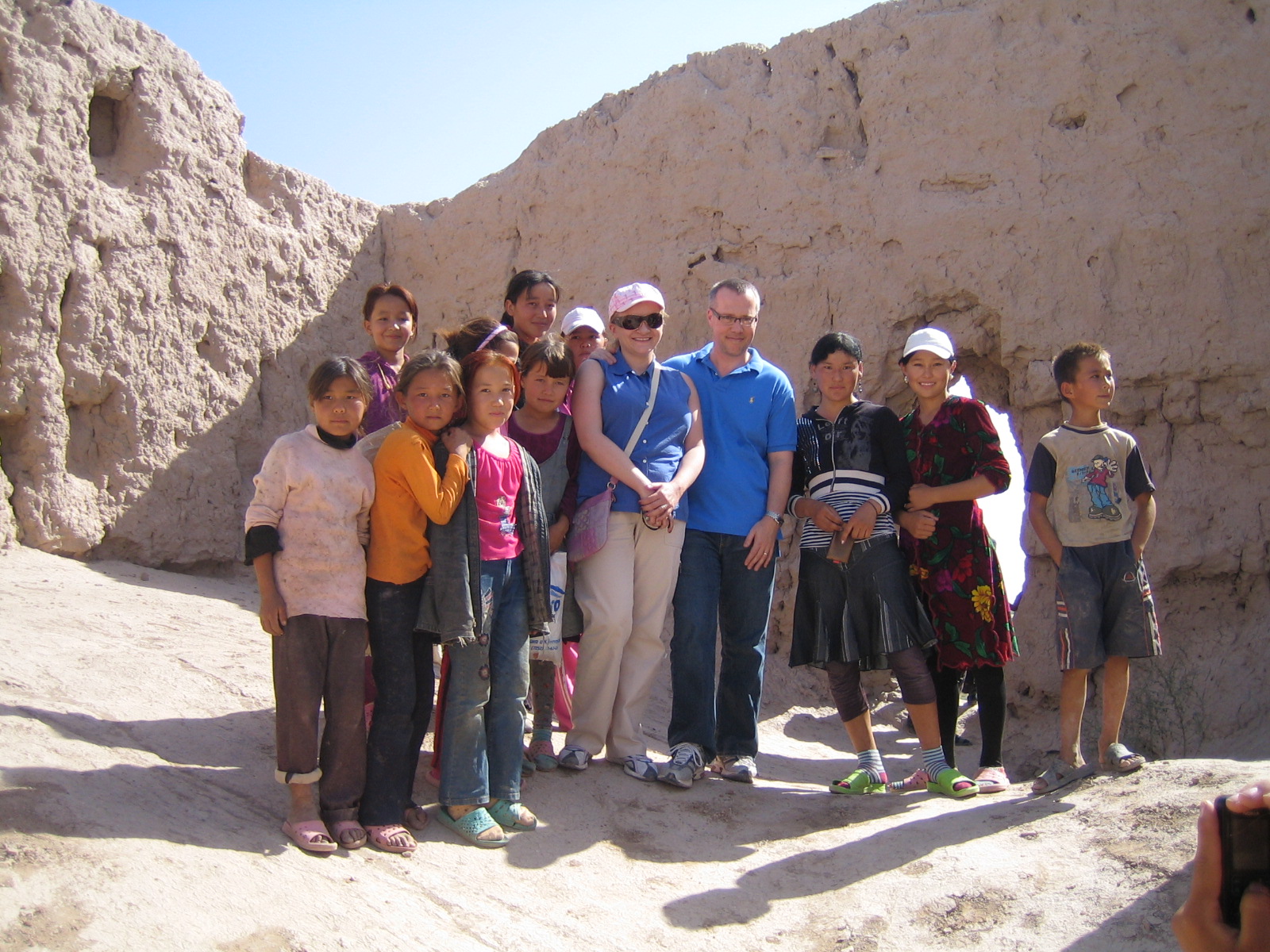
I got some experience on the trip watching some Kazakh school children picking cotton and wanting their pictures taken with us. (In the picture to the left is my friend Alexandra and her husband, Terry, with a few of the children we met.) I experienced eating lunch in a yurt (a felt covered mobile home shaped like an igloo but kind of tee-pee like). I experienced in Uzbek art. Islam does not allow depictions of living things so their art is either thinly disguised people and animals or landscapes and still life. As we drove the two and a half hours to Moynoq we'd occasionally see a man squatting at the side of the road. This aroused my curiosity as there were no structures in sight. (See the above picture of the dry Aral Sea bed - the land we drove through didn't look that much different.) Where did he come from? Where was he going? How would he get there? There is a whole different world of experiences here for me.
After the roadtrip and staying in my first Uzbek hotel and seeing the yurt I was heartened that upon returning to our house here in the compound I felt like I was coming home.


Monday, September 20, 2010

Back to the Desert


Note to readers: I know, I know - my picture placement, sizing, etc. leaves everything to be desired. I'm learning. Bear with me. My writing is much better . . .


The desert can be a very deceitful place especially if you are unfamiliar with it. I was born in a desert and it always upset me to hear people say "There's nothing there." It didn't make me angry-upset; it confused me and gave me not a little pity for them. For I had sat in the backseat of our family car and ridden through Death Valley in the summer time and seen the same thing they had seen. They saw nothing; I saw space.* I saw ground that allowed growth in the most unlikely places. I saw sky uninterrupted by steel-constructed sky scrapers (which, to me, scraped the sky bloody). I saw potential - not like a land "developer" (read: ruiner) would. I saw true freedom. Freedom to wander forever, to let my feet go one way and my thoughts go another. I saw privacy - a necessity. If you live in the uncivilized desert your contact with people is rarer and more deliberate, not forced daily.

The desert doesn't give much to us, we must hunt and gather to receive its offerings. We have to look closely to see that gila monster or snake since they so ingeniously blend into their environment, unlike we humans. It takes some work, sometimes, to see things in the desert. And we don't like to work, do we? One cannot live unconsciously in the desert as one can in a city where there is always a sign telling you explicitly what to do and where to go. The signs in the desert are more cryptic.

Part of the nothingness people see is their perceived lack of color in the desert. The desert isn't obvious with its sharing its many colors.

These two plants are the same type of plant seen at diferent angles. What a difference in color!

The greens of the cacti are dusty and soft. The mountains are a strong and quiet granite-blue. Ireland is praised for it's forty shades of green. No one sings of the deserts forty shades of tan and brown. Again, it takes thought to see color in the desert unless it is sunrise or sunset when the sky edges the darker land under the purple mountains with an orange-peach-pink glow. It takes thought and effort to see the color in the desert - that lizard is not the exact same shade as that rock! - unless the cacti are in bloom. That is as aggressive as the desert gets with its color. Maybe it's stingy. Maybe it saves the treats for occasions instead of spoiling us. You can learn appreciation in the desert.

When I was 28 I left the desert for Minnesota and North Carolina - both of which are about as polar opposite as one can get from Phoenix. Minnesota's cold shocked and hurt me after Phoenix's intense heat. The moisture of North Carolina soothed me but made it a challenge to look good in the humid summers.

When I lived in Phoenix I drove around in a convertible with the top down - no air conditioner - all summer long. It felt good. After years of living in Minnesota and North Carolina my routine February trip home somehow migrated to July. The heat and the sun's intensity were not as comfortable any more. I had gone from one extreme to the other. The last summer I was in Phoenix it hit a record 122 degrees and when I arrived in Minnesota they had the famous "Halloween Storm" when it snowed a record 28+ inches before the plows were ready for winter.
Not only did I have to change outwardly in buying a new wardrobe I had to change inwardly in my attitude toward the extreme weather. All this while learning to navigate a new city, find a new job and new friends.
Last Monday, September 13, 2010, I began repeating this process in Tashkent. There are a few more variables this time - new language, new food, new cultures (both the local culture and the Embassy culture).
My life is so different today than when I lived in Phoenix. I'm married. I am unemployed. I have all the freedom in the world to do and learn and experience. I am different within myself. I am much more disciplined, less selfish and more broad minded. I never again want to live as I did in Phoenix yet I can't help but wonder if something - even one aspect - will come full circle in my return to the desert.
The vans you see are ours. We are standing on an ancient fort built of mud.
*I recently read a book by Mary Doriah Riley called "Children of God". In the book a signal is heard from space. The sound is of singing. A group travels through space to make contact with a planet's known inhabitants. One of the members of the team is a linguist who, after listening to the singing, figured out a good deal of the language. These beings do not have a word for 'ceiling', 'floor', or 'wall' even though their structures have all those features. They refer to their dwellings by a word that indicates the space within those peramiters. I thought that was very interesting.